
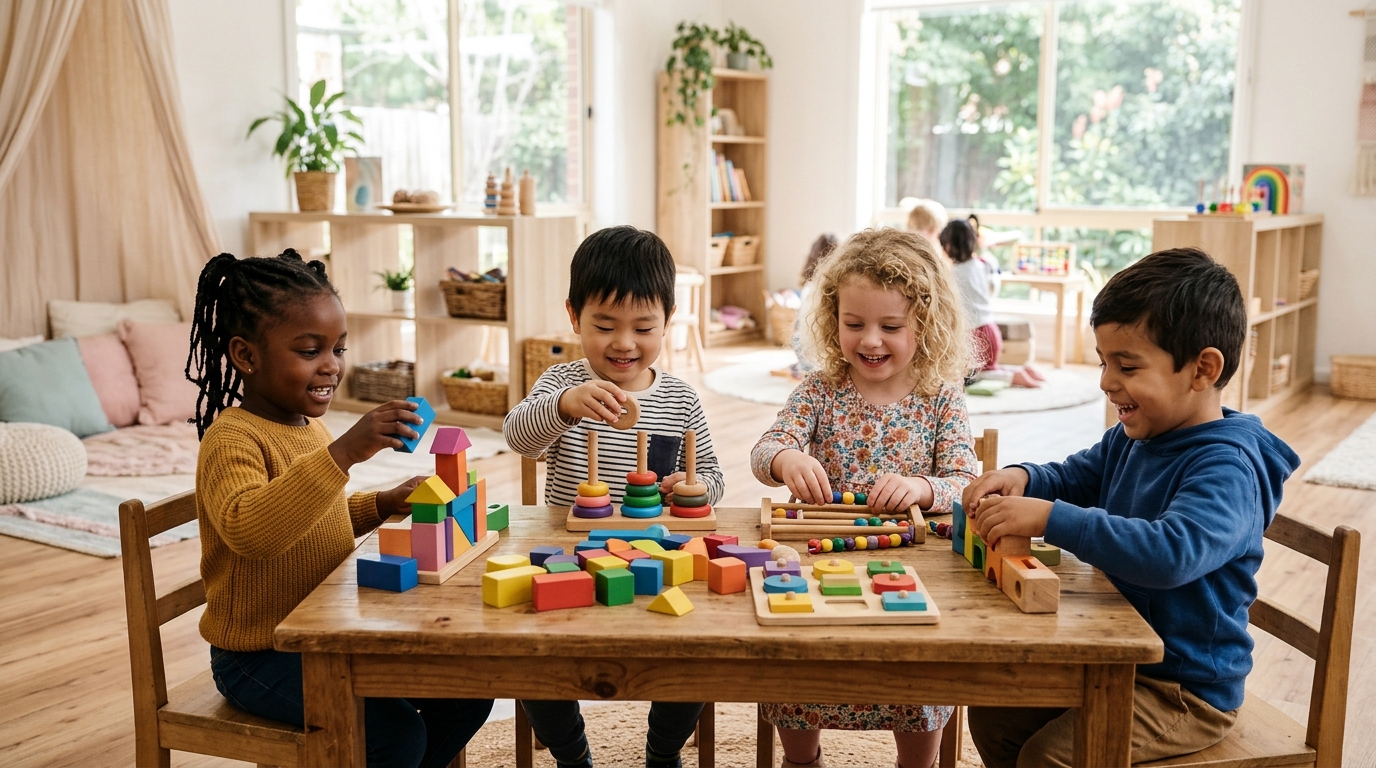
Early childhood is not merely a preparation stage for primary school—it is a critical, irreplaceable window of neurodevelopmental growth. At Ompee International School Sec 81 (Junior wing), our pedagogy centers on experiential, hands-on learning that transforms curiosity into lasting cognitive capability.
Why Experiential Learning Outperforms Rote Learning
Traditional early education models often rely heavily on repetition and desk-bound instruction. However, developmental science consistently shows that young children between ages 2 and 6 construct knowledge primarily through physical interaction with their surroundings.
When children touch tactile materials, sort geometric blocks, mix primary colors, or explore natural outdoor gardens, their brains form dense neural networks linking sensory input, language, and executive functioning.
Key Pillars of Experiential Learning at Ompee Junior Wing
- Sensory Discovery Zones: Dedicated sand, water, kinetic, and tactile sensory exploration spaces that refine fine motor dexterity and spatial awareness.
- Inquiry-Driven Play: Rather than giving immediate answers, educators prompt questions like “What happens if we balance this block here?”, teaching organic problem-solving.
- Integrated Early STEM: Age-appropriate counting manipulatives, nature measurement experiments, and light tables introducing basic scientific logic without anxiety.
- Expressive Arts & Music: Creative movement, percussion rhythm drills, and finger painting that unlock emotional expression and fine muscle control.
The Role of Safe, Purpose-Built Classrooms
Every classroom at Ompee International School Sec 81 is purposefully curated as an educational laboratory. Ergonomic child-proof furnishings, rounded corners, natural air filtration, and accessible open shelving empower toddlers to select learning apparatus independently, fostering self-reliance from the very first year.
“When a child solves a physical puzzle with their own hands, the feeling of discovery creates genuine, self-sustaining academic confidence.”
How Parents Can Foster Experiential Play at Home
You don’t need expensive gadgets to foster hands-on learning at home. Simple daily habits can make a tremendous difference:
- Involve them in everyday kitchen measurements: Counting spoons, feeling textures of lentils and grains, or observing dough rising.
- Encourage nature scavenger hunts: Collecting leaves of different shapes, observing birds, and sorting stones by size.
- Embrace unstructured block play: Resisting the urge to fix their tower and letting them test gravity and balance independently.
To learn more about our child-first curriculum and campus facilities, we invite families to visit our campus at Landmark The Homes 81, Sector 81, Gurugram or schedule a personalized walk-through.

Leave a Reply